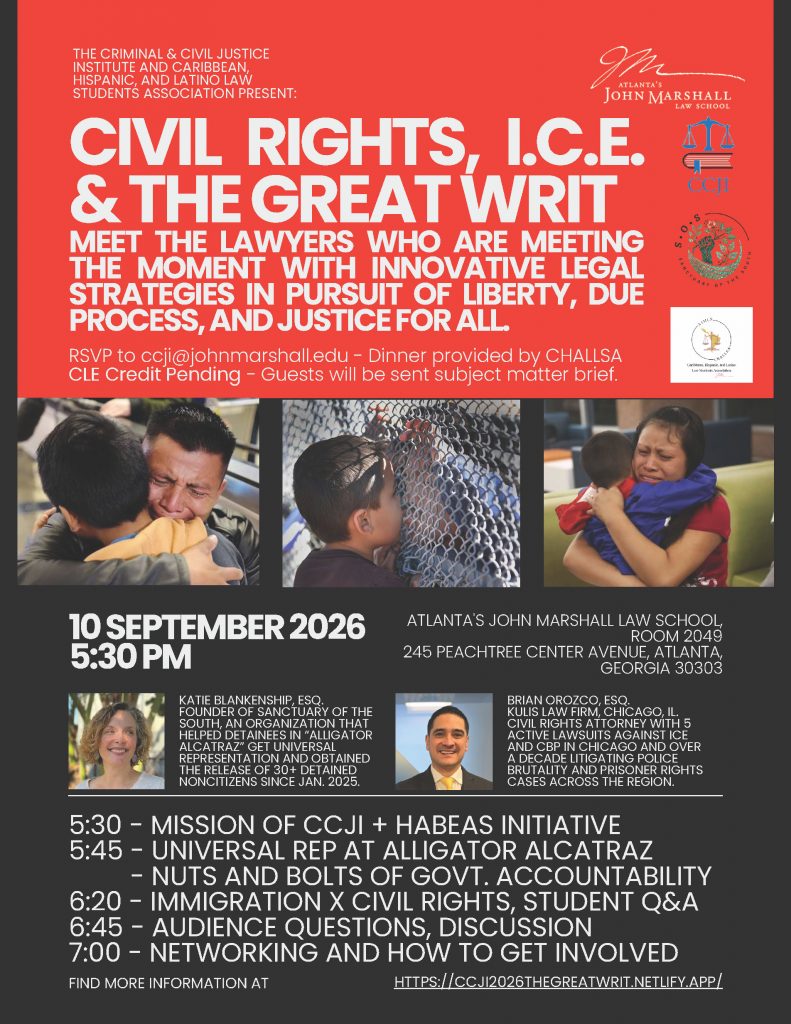
Meet The Lawyers Who Are Meeting The Moment With Innovative Legal Strategies In Pursuit Of Liberty And Justice For All.
Hosted and provided by CCJI and CHALLSA · Dinner provided by CHALLSA · CLE Credit Pending
Come Eat, Learn, and Get Involved
Thursday, September 10, 2026 · 5:30 p.m. – 7:00 p.m. (evening students will be dismissed at 6:20 p.m.)
Atlanta’s John Marshall Law School · Room 2049
245 Peachtree Center Avenue, Atlanta, Georgia 30303
Seats Limited, please RSVP to ccji@johnmarshall.edu
Confirmed guests will be sent a subject matter brief prior to the event.
ICE detention has hit record highs, most people detained have no criminal conviction, and few have a lawyer or any guarantee of one. Civil rights violations, deaths, and abuses often go unremedied.
But reform is happening, case by case, through lawyers who are willing to demand accountability and due process for their clients even when the cases are far from easy or definite.
Atlanta’s John Marshall Law School’s Boz DelMundo, a student volunteer for the Habeas Initiative, will be introducing two of these lawyers who are at the forefront of this issue at the national level.
The Panel will Feature Special Guests:
Katie Blankenship is an immigration attorney, former ACLU, civil litigator, and founder of Sanctuary of the South, a grassroots legal services organization built to serve immigrant families across the South. She was co-counsel and SOS was an organizational plaintiff in the case that forced “Alligator Alcatraz” to open its doors and provide reliable access to counsel for detainees — pressure that helped lead to the facility’s closure. SOS’s habeas practice has freed dozens of people from detention to date.
Brian Orozco is a Civil rights attorney at Kulis Law with five active lawsuits against ICE and counting. A DePaul Law graduate, Brian has spent over a decade litigating police brutality and prisoner rights cases across Illinois, Indiana, and Wisconsin, representing incarcerated clients in every federal district and maximum-security facility in the state. He’s now applying that same demand for remedy to ICE conduct: discovery, preserving the claim, and unmasking the people who have commited the harm.
– – –
What will law students and attorneys learn from this program?
“A social engineer is a highly skilled, perceptive, sensitive lawyer who understands the Constitution of the United States and knows how to explore its uses in the solving of problems of local communities and in bettering conditions of the underprivileged citizens.”
— Charles Hamilton Houston
Being a “social engineer” through civil rights work is as important now as it ever was. This work is not only about representing those who are being persecuted, but also about upholding the rule of law with the future of our nation in mind. That is what the attorneys on this panel are doing right now.
The nexus of immigration law and civil rights advocacy is as broad as it ever has been. Protesters clash with federal agents on America’s streets, detention centers pop up like POW camps, and the Fourth Amendment appears to be ignored — all in the name of “Protecting the American People Against Invasion” Exec. Order No. 14,159, 90 Fed. Reg. 8443 (Jan. 20, 2025).
ICE detention reached a record high of over 70,000 people in January 2026. Nearly three quarters of those detained have no criminal conviction. Transactional Records Clearinghouse, Taking Stock: Trump Administration Record on Detention and Removals (Jan. 2026), https://tracreports.org/reports/767/. Most have no lawyer, nor are they guaranteed one. Detainees range from child to elderly and can be held from months to over a year. Civil rights violations, deaths, and abuse have largely gone unchecked and unremedied.
There is resistance, however. Katie Blankenship and Brian Orozco are not accepting these impositions on life and liberty for their clients. They join this panel to discuss the role that civil rights attorneys have long played in setting and holding the standard for what Americans expect from their government.
Reform and accountability rarely come all at once — they come case by case. We’ll explore the panelists’ impact litigation, including:
– Injunction requiring ICE to provide people detained at “Alligator Alcatraz” access to legal counsel
– Lawsuits filed against Border Patrol for Midway Blitz excessive force
Blankenship was co-counsel and an organizational plaintiff on the litigation team behind the injunction, the case that opened the doors to counsel at Alligator Alcatraz and helped lead to its closure. Orozco, meanwhile, is representing plaintiffs who have been harmed by ICE and CBP during Operation Midway Blitz in Chicago last fall, including a baby and a U.S. citizen who was pulled from his car and restrained despite identifying himself. Orozco’s suits, alleging Fourth Amendment violations among other tort claims, face an uphill battle as recovery against federal agents is no easy feat. Orozco does not shy away from such challenges, however, as he himself was tear-gassed while representing clients at one of the confrontations.
Ahead of the panel, we will send out a short set of cases and articles for attendees to review, and a link for students to submit questions.