
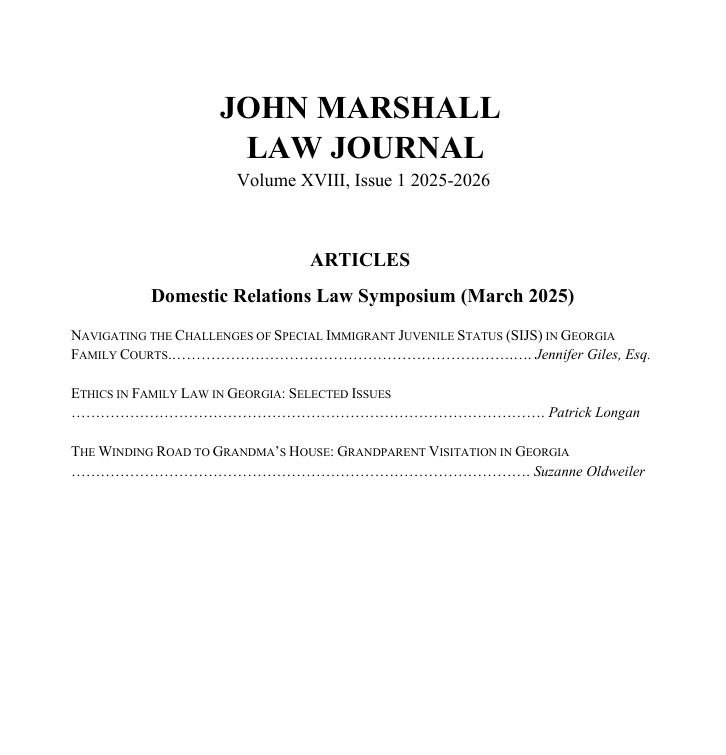
Atlanta’s John Marshall Law School (AJMLS) and the Editors of the John Marshall Law Journal are proud to announce the publication of Volume XVIII, Issue 1 of the Law Journal. For this latest issue, the Law Journal commissioned three lead articles in connection with its March 2025 Domestic Relations Law CLE Symposium. An AJMLS faculty member contributed the first article. A member of the Mercer Law School faculty, who has also taught at AJMLS, contributed the second article. The third article was contributed by a recent AJMLS alumna and family law practitioner, who also served as Editor-In-Chief of the Law Journal. Taken together, they reflect the Law School’s commitment to rigorous analysis, innovation in legal education, and recognition of AJMLS’s history of producing real lawyers to serve real people.
Navigating the Challenges of Special Immigrant Juvenile Status in Georgia Family Courts
The AJMLS faculty is represented by Associate Professor Jennifer Giles, whose article was adapted from materials prepared for the 2025 Symposium. Professor Giles has real-world experience in her topic; she launched her legal career in 2005 with the Atlanta Legal Aid Society, helping low-income people navigate the complexities of the court system at the most vulnerable times in their lives, and engaged in the private practice of family law for several years thereafter. Professor Giles teaches courses including Legal Research, Writing & Analysis I & II, Trial Advocacy, and Trial Advocacy Writing.
In Navigating the Challenges of Special Immigrant Juvenile Status in Georgia Family Courts, Professor Jennifer Giles examines the legal and procedural challenges undocumented minors face in obtaining Special Immigrant Juvenile Status (SIJS) in Georgia. She explains how the federal SIJS framework, designed to protect vulnerable immigrant youth who cannot return to their home countries due to abuse, neglect, or abandonment, depends in part on state court findings and procedures. Her work provides both a foundational overview of the SIJS process and a critical examination of Georgia-specific obstacles affecting at-risk youth.
Ethics in Family Law in Georgia: Selected Issues
Professor Patrick Longan is a renowned legal scholar and law teacher. He holds the William Augustus Bootle Chair in Ethics and Professionalism and the Practice of Law at Mercer Law School. He has published extensively on ethics and professionalism, and his article here is a bible for family law practitioners in navigating the numerous, and thorny, issues of ethics and professionalism that face family law practitioners every day. Professor Longan serves on the State Bar of Georgia’s Formal Advisory Opinion Board and its Disciplinary Rules and Procedures Committee. In 2018, the Supreme Court of Georgia appointed Professor Longan as one of twenty special masters who hear disciplinary cases involving lawyers in Georgia. His son, Dr. Mitchell Longan, is a member of the AJMLS Faculty.
In Ethics in Family Law in Georgia: Selected Issues, Professor Patrick Longan examines the ethical challenges that arise in the practice of family law in Georgia, emphasizing the unique and recurring professional responsibility issues that accompany domestic relations matters. He analyzes selected topics based on their relevance to recent and proposed changes to the Georgia Rules of Professional Conduct, their frequency among family law practitioners and judges, and areas where Georgia law diverges from the ABA Model Rules or formal ethics opinions. Professor Longan’s work offers practical guidance on lawyers’ duties to clients, third parties, and the courts, while highlighting evolving ethical considerations in Georgia family law practice.
The Winding Road to Grandma’s House: Grandparent Visitation in Georgia
Suzanne Oldweiler is a domestic relations attorney at Kessler & Solomiany, AJMLS alumna, and Editor-in-Chief Emeritus of the John Marshall Law Journal (2024-2025). Attorney Oldweiler was previously published twice in the John Marshall Law Journal, including her Recent Case Summary on Namdar-Yeganeh v. Namdar-Yeganeh, 369 Ga. App. 700, 894 S.E.2d 466 (2023), cert. den. Apr. 16, 2024, which considered whether Georgia law authorizes a grandparent to petition for modification of an existing grandparent visitation order. See 17 J. Marshall L.J. 323 (2023).
In The Winding Road to Grandma’s House: Grandparent Visitation in Georgia, Oldwiler examines the evolving legal landscape of grandparent visitation in Georgia and across the United States. She situates the discussion within the broader cultural recognition of grandparents and the enduring importance of grandparent-grandchild relationships, which have been acknowledged both socially and legislatively, including through the establishment of Grandparents Day. Her analysis explores the role of grandparents in family life and evaluates the structure, application, and continuing transformation of Georgia’s grandparent visitation law.
These articles are found at the Law Journal’s open-access page on the AJMLS Website, and are also available on Westlaw, Lexis, and Hein-On-Line.
The Journal’s Faculty Advisor, Professor Van Detta, has expressed his great appreciation for the exceptional efforts by Madeline Townsend, Volume 19’s Editor-in-Chief, and Chloe Strickland-Teems, Volume 19’s Executive Managing Editor, to bring this issue to fruition before their graduation.
Together, the works in this issue reflect the Law Journal’s enduring mission to elevate legal scholarship, foster thoughtful dialogue on pressing issues facing the legal profession and family law practice, and honor the history, community, and academic tradition of Atlanta’s John Marshall Law School.